
LLC vs. Sole Proprietor Banking
A sole proprietorship and an LLC can look similar on a federal tax return while requiring different legal names, account ownership, opening documents, and deposit-insurance calculations.
Short answer
Sole proprietor and LLC banking differ because the owner differs. Title the account to the actual owner, use the correct identification and documents, calculate FDIC coverage under the correct category, and record every owner transfer. A disregarded federal tax status does not make an LLC bank account personal, and an LLC bank account alone does not complete the legal boundary.
At a glance
8min read
Separate legal form from tax classification
Banking differences at a glance
Account title should match the actual owner
EIN rules require precision
Opening-document checklist
Key takeaways
- 1
A sole proprietorship is not a separate legal entity; an LLC is formed under state law and should bank in its registered legal name.
- 2
A single-member LLC can be disregarded for federal income tax while remaining a separate state-law entity.
- 3
Some sole proprietors can use an SSN, while LLC and employer circumstances can require or justify an EIN; obtain it free from the IRS.
- 4
FDIC treats sole-proprietorship deposits as the owner’s single accounts, while a valid LLC engaged in independent activity can qualify for separate business-category coverage.
- 5
Neither account type makes personal expenses deductible; document every contribution, draw, distribution, loan, reimbursement, and payment.
Read the guide
Banking should reflect the entity that actually earns and spends the money. It should also preserve the difference between business costs, owner transfers, reimbursements, loans, and compensation.
Separate legal form from tax classification
A sole proprietorship exists when one person conducts business without forming another entity. The SBA explains that it does not create a separate business entity, so business assets and liabilities are not separated from the owner's personal assets and liabilities.
Keep reading
An LLC is formed under state law. Its owners are members, and state filing, operating-agreement, annual-report, license, and name rules vary. The SBA notes that LLCs generally provide personal-liability protection in many circumstances, but legal protection is not absolute and depends on facts and law.
Federal tax classification is a different layer. The IRS says a single-member LLC is generally disregarded for federal income tax unless it elects corporate treatment.
Its business activity may appear on the owner's return in a manner similar to a sole proprietorship. That tax treatment does not erase the LLC's state-law existence or justify putting entity money in an account owned personally.
Banking differences at a glance
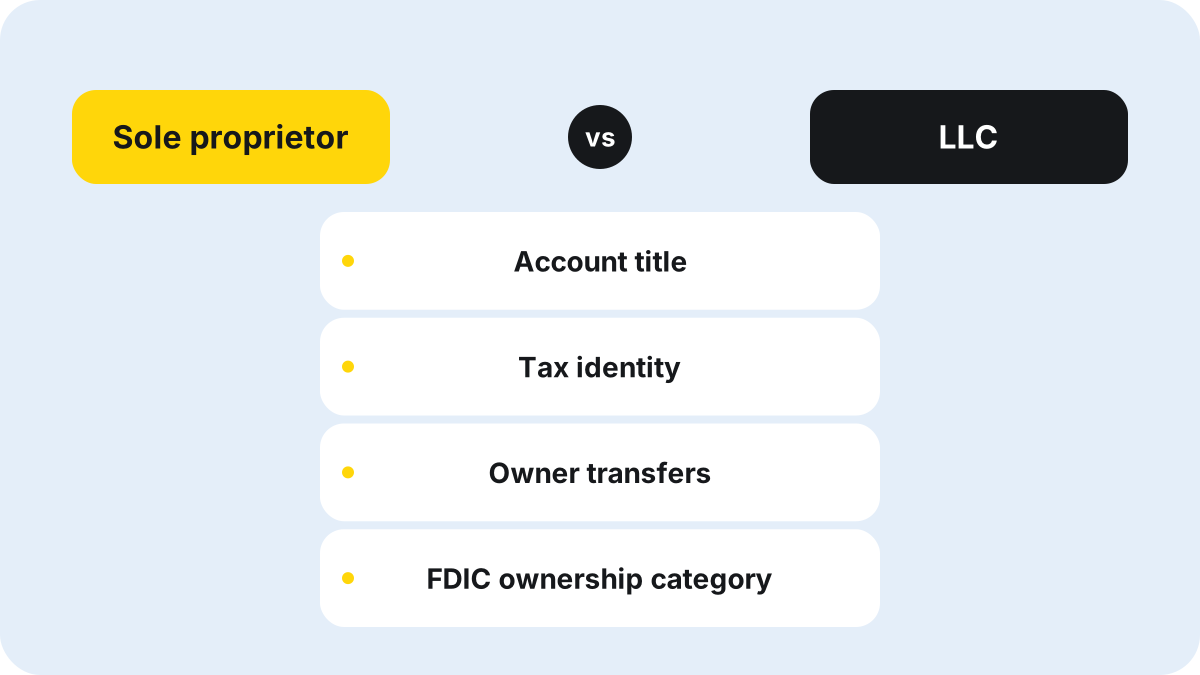
| Question | Sole proprietor | Single-member LLC, default tax treatment |
|---|---|---|
| Legal owner of business assets | Individual owner | LLC under state law |
| Typical account title | Owner name, often with registered DBA | Exact LLC legal name |
| Common tax ID at opening | SSN or EIN, depending on bank and circumstances | EIN often used for banking; federal income-tax reporting rules can still reference owner TIN |
| Formation evidence | DBA/license if applicable | Articles or certificate of organization, operating agreement, licenses |
| Owner cash out | Usually owner draw | Member draw/distribution under applicable accounting and tax treatment |
| FDIC category | Owner's single-account category | Business/organization category if validly formed and independently active |
The table is a general operating guide, not entity-specific legal or tax advice. An LLC taxed as an S corporation, an LLC with employees, a multi-member LLC, and an LLC subject to excise tax can have different identification, payroll, and filing requirements.
Account title should match the actual owner
A sole proprietor can operate under the owner's legal name or a properly registered assumed name, commonly called a DBA. The account may be titled “Jordan Lee DBA North Street Design,” depending on bank practice and local registration. The owner remains the depositor and legal business owner.
Keep reading
An LLC account should use the registered LLC name shown on state formation records. Client contracts, invoices, payment-processor profiles, W-9 information, licenses, and banking records should be reconciled for consistent identity. A brand or DBA can be added when properly registered, but it should not replace the underlying legal owner.
Do not deposit LLC revenue into an account owned by the member merely because both appear in the same app. Do not pay the member's groceries, mortgage, or unrelated personal bills as if they were LLC operating costs. If money crosses the boundary, label and support the movement.
EIN rules require precision
The IRS provides EINs free. It says a sole proprietor generally needs one when hiring employees or meeting other specified tax obligations, and may request one for banking or state-tax purposes even when not federally required.
Keep reading
For a single-member LLC, the IRS explains that a disregarded entity without employees or excise-tax liability may not need an EIN for federal income-tax purposes. It can nevertheless obtain an EIN when a bank or state requires one. The LLC must use its own EIN for certain employment and excise-tax requirements.
Form the LLC with the state before applying for the EIN. Use the entity name exactly as formed and save the IRS confirmation. Do not assume that changing from sole proprietor to LLC always preserves the old identification setup; consult the IRS “When to get a new EIN” guidance and a tax professional for the specific transition.
Opening-document checklist
For a sole proprietor, prepare:
- government identification and address information;
- SSN or EIN as appropriate;
- assumed-name or DBA certificate if used;
- business license or professional license where applicable;
- industry, expected activity, and source-of-funds details.
For an LLC, add:
- state-filed articles or certificate of organization;
- EIN confirmation where applicable;
- operating agreement or ownership record;
- resolution or authority showing who can open and control accounts, when requested;
- information for members, managers, controllers, and authorized signers;
- assumed-name registration and licenses where applicable.
Bank requirements vary. A single member is not the same as a single authorized user; the operating agreement and bank mandate should determine who can transact.
Deposit insurance is not the same
The FDIC treats a sole proprietorship as having no separate legal identity from its owner. Deposits in the DBA or sole-proprietorship account are combined with the owner's other single-category deposits at the same insured bank.
Keep reading
A valid LLC engaged in an independent activity can qualify for the FDIC business/organization category, separate from the member's personal categories. The category generally provides up to $250,000 per insured bank for the entity, not $250,000 per member, account, department, or signer.
Owner contributions and money out
Every transfer needs a business explanation. A sole proprietor putting $10,000 into the business can record owner capital; taking $2,000 for household use can be an owner draw. Those transfers are not customer revenue or vendor expense.
Use a transfer log:
| Date | From/to | Amount | Classification | Evidence |
|---|---|---|---|---|
| Jul 2 | Member → LLC | $5,000 | Capital contribution | Operating agreement/ledger memo |
| Jul 15 | LLC → member | $320 | Expense reimbursement | Receipt and approved report |
| Jul 31 | Business → owner | $2,000 | Draw or distribution | Cash review and ledger entry |
Keep reading
An LLC member may contribute capital, lend money under a real loan arrangement, receive reimbursement, take a distribution, or receive compensation depending on the entity's tax classification and facts. The bookkeeping labels and supporting documents should match reality. A generic transfer marked “payment” is weak evidence.
Do not call a transfer a reimbursement without the underlying business expense. Do not call an undocumented, recurring owner payment “payroll” unless the entity and payroll process support that treatment.
Paying expenses and preserving deductions
The bank account documents payment; it does not decide tax deductibility. IRS Publication 583 says supporting records must establish the business transaction and that proof of payment alone does not prove entitlement to a deduction.
Keep reading
Pay business costs from the business account or card and attach the invoice, receipt, contract, and business purpose. If the owner pays personally, submit a documented reimbursement or contribution entry instead of ignoring the transaction. If the business accidentally pays personally, classify it correctly rather than leaving it inside supplies, travel, or another expense category.
Reconcile monthly. Match processor payouts to gross receipts and fees, investigate checks and transfers that have not cleared, record bank charges, and ensure the ledger equals the statement after reconciling items.
Moving from sole proprietor to LLC
Do not simply rename the old account. Use a controlled transition:
- Form the LLC and obtain state evidence.
- Obtain the appropriate EIN and licenses.
- Open an account owned by the LLC.
- Update contracts, W-9 information, invoices, processor profiles, insurance, and payment instructions.
- Document assets and cash contributed or sold to the LLC.
- Run an overlap while old receivables and checks settle.
- Close or retain the sole-proprietor account only after unresolved activity is handled.
State taxes, sales taxes, professional licenses, contracts, and permits may not transfer automatically. An LLC formation service or bank account is not a complete conversion plan. Use legal and tax professionals where the amounts or risks are material.
Current BOI and bank ownership questions
FinCEN's March 2025 interim final rule exempted entities created in the United States from Corporate Transparency Act beneficial-ownership reporting. That does not mean a bank must ignore owners or controllers. Customer-identification, sanctions, fraud, and other bank compliance processes can still require ownership and control information.
Keep reading
Answer the bank's current application accurately and distinguish the purpose of the request. Do not submit an outdated BOI filing merely because an old checklist says every domestic LLC must file, and do not refuse a bank ownership question because domestic CTA reporting changed.
Which setup is right?
Choose legal form based on liability, ownership, tax, administrative, financing, and state-law considerations—not on which account looks easier. The SBA describes a sole proprietorship as simple and fully controlled by one owner, while an LLC can provide liability protection in many instances and more formal separation.
Keep reading
Once the structure is chosen, banking should implement it faithfully. A sole proprietor still benefits from a dedicated account and clean records.
An LLC needs the account plus consistent contracts, capitalization, approvals, books, filings, and insurance. Neither structure excuses weak cash controls.
Glossary
Frequently asked questions
Can a single-member LLC use the owner’s personal bank account?
The LLC should use an account owned and titled in the LLC’s legal name. Federal disregarded tax treatment does not erase the entity’s state-law identity or make its money personal.
Does a sole proprietor need a business bank account?
A dedicated account is the stronger recordkeeping practice and may be required by the account agreement or payment relationships. The IRS recommends separating business and personal checking.
More answers (3)
Does a single-member LLC need an EIN to open a bank account?
A bank or state may require one even when the LLC does not need one for federal income-tax purposes. The IRS allows an eligible LLC to obtain an EIN for banking; form the entity first.
Are LLC deposits insured separately from the owner’s personal deposits?
A valid independently active LLC can qualify for the FDIC business/organization category. A sole proprietorship does not; its deposits are aggregated with the owner’s single accounts.
Can I convert a sole-proprietor bank account by changing its name?
Usually the legal owner must change, so use a controlled transition with formation documents, tax ID, a new entity account, updated payment instructions, and documented asset or cash transfers.
Try the numbers yourself
Sources (7)
Facts checked Updated- SBA — Choose a Business Structuresba.gov
- IRS — Single-Member Limited Liability Companiesirs.gov
- IRS — Employer Identification Numberirs.gov
- IRS — Publication 583: Starting a Business and Keeping Recordsirs.gov
- FDIC — Single Accounts and Sole Proprietorshipsfdic.gov
- FDIC — Corporation, Partnership and Unincorporated Association Accountsfdic.gov
- FinCEN — Beneficial Ownership Information Reference Materialsfincen.gov
Fact-check dates show when the published facts were checked against the cited sources. They do not guarantee that terms have stayed the same.