
What Is FDIC Insurance?
FDIC insurance protects eligible deposits if an FDIC-insured bank fails.
Short answer
FDIC insurance is strong protection for eligible bank deposits, but it is calculated by depositor, insured bank, and ownership category. Verify the legal institution, distinguish deposits from investments, aggregate all relevant accounts, and use EDIE with accurate titles and balances. When the structure is complex, obtain a specific answer before the bank balance grows beyond the amount you know is covered.
At a glance
7min read
What the insurance actually does
Products that are and are not deposits
The standard aggregation rule
Common ownership categories
Joint and individual example
Key takeaways
- 1
The standard coverage limit is $250,000 per depositor, per FDIC-insured bank, for each ownership category.
- 2
Checking, savings, money market deposit accounts, and CDs are deposit products; stocks, mutual funds, crypto, annuities, and safe-deposit-box contents are not FDIC-insured.
- 3
Multiple accounts in the same ownership category at the same bank are aggregated rather than insured account by account.
- 4
Different branches of the same chartered bank do not create separate coverage, while separately chartered insured banks generally do.
- 5
Use FDIC BankFind and EDIE with exact titles and balances instead of relying on logos or rough mental math.
Read the guide
The standard limit is $250,000 per depositor, per insured bank, for each ownership category—not per account, branch, or app. Correct coverage depends on the legal bank, account title, ownership category, beneficiaries, and the bank’s records.
What the insurance actually does
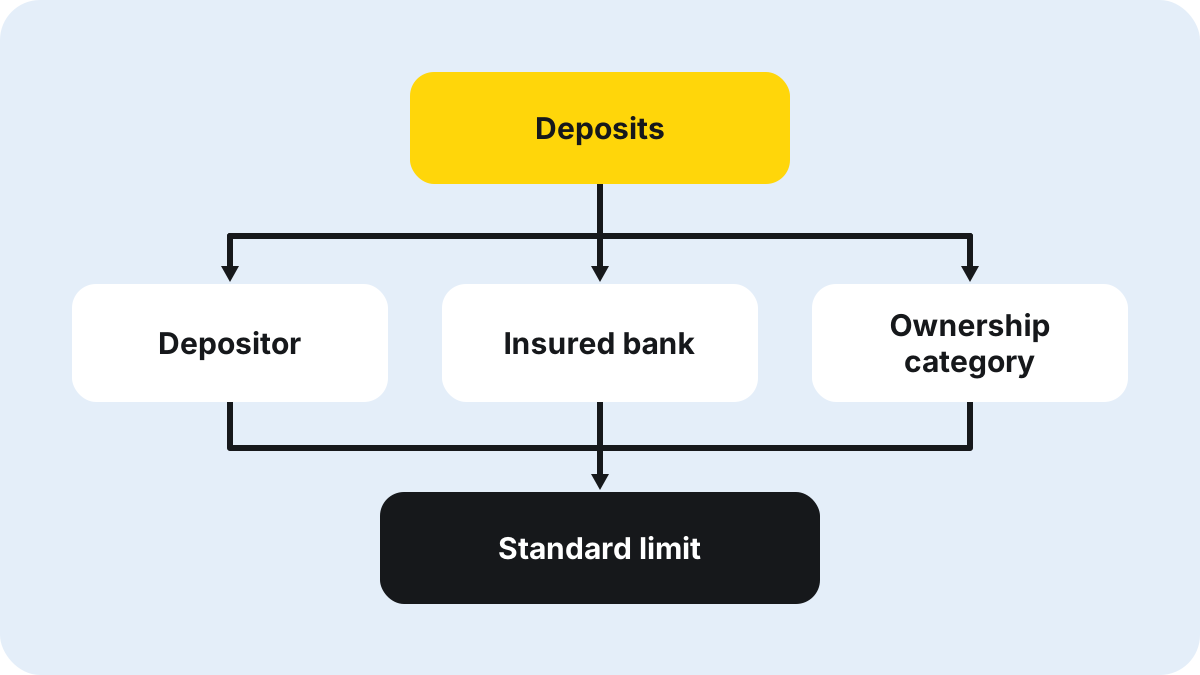
The Federal Deposit Insurance Corporation insures eligible deposits at member banks and manages the resolution of failed insured banks. If an insured bank closes, deposit insurance protects covered principal and accrued interest through the date of failure, up to the applicable limits. The FDIC's stated standard is $250,000 per depositor, per FDIC-insured bank, for each account ownership category.
Keep reading
That sentence has four separate tests: who owns the money, which legal bank holds it, which ownership category applies, and how much is in that category. Product names and the number of account screens do not decide coverage.
Products that are and are not deposits
FDIC materials list checking accounts, savings accounts, money market deposit accounts, and time deposits such as certificates of deposit as covered deposit products at insured banks. Cashier's checks, money orders, and other official items issued by the bank can also be deposits under the applicable rules.
The FDIC does not insure:
- stocks, bonds, or mutual funds;
- crypto assets;
- life insurance policies or annuities;
- municipal securities;
- safe-deposit boxes or their contents; or
- losses caused merely by the market value of an investment falling.
Keep reading
An insured bank can sell an uninsured investment. Buying it in a bank branch or seeing it beside a savings balance does not turn it into a deposit. U.S. Treasury securities are not FDIC-insured, although direct Treasury obligations have a separate backing by the federal government.
Deposit insurance also does not reimburse an authorized scam transfer, identity theft loss, account fee, or ordinary dispute with a merchant. Other laws and bank protections may matter, but they are not the same as bank-failure insurance.
The standard aggregation rule
The three deposits are added because the same depositor owns them in the same category at the same bank. Under the standard limit, $250,000 is within the limit and $35,000 exceeds it. Opening a fourth individual savings account or moving the CD to another branch of the same bank would not create another limit.
Keep reading
If Maya moves the CD to a separately chartered FDIC-insured bank, deposits at that bank are calculated separately. Verify that the institutions are legally distinct in BankFind; different brand names can sometimes belong to the same charter, and one bank can operate many branches.
Common ownership categories
FDIC ownership categories include single accounts, joint accounts, certain retirement accounts, trust accounts, employee benefit plan accounts, corporation/partnership/unincorporated-association accounts, and government accounts. Each category has requirements; an account nickname does not select one.
Keep reading
Single accounts
Individual accounts without beneficiaries are generally aggregated with that owner's other single-category deposits at the bank. The FDIC guide also explains that sole-proprietorship deposits are insured as the owner's single accounts, not as a separately incorporated business category.
Joint accounts
Qualifying joint deposits are calculated using each co-owner's interests across all joint accounts at the same bank. A two-owner joint account is not simply “one $500,000 account” in every circumstance; the account records, co-owners, withdrawal rights, and each person's combined joint interests matter.
Certain retirement accounts
Eligible self-directed retirement deposits, such as deposit IRAs, use a separate category under FDIC rules. An IRA invested in mutual funds or securities is not converted into an insured deposit just because the custodian is associated with a bank.
Trust accounts
Trust coverage depends on owners, eligible beneficiaries, allocation rules, and account records. The FDIC's revised trust-account rule took effect April 1, 2024 and combined revocable and irrevocable trust deposits into a trust-accounts category for calculation purposes.
Simple “$250,000 times every name” shortcuts can be wrong, particularly with multiple owners, six or more beneficiaries, unequal interests, or ineligible beneficiaries. Use EDIE and obtain professional advice for material trust balances.
Business entity accounts
Deposits owned by a corporation, partnership, or unincorporated association engaged in an independent activity can use the business-entity category. Dividing the same entity's money into payroll, tax, and operating accounts at one bank does not create separate limits. A sole proprietorship is treated differently, as noted above.
Joint and individual example
Alex holds $240,000 in an individual savings account at Bank A. Alex and Jordan also hold a qualifying $400,000 joint account there, with equal interests and no other joint accounts at that bank.
Keep reading
Alex's $240,000 individual deposit is considered in the single-account category. Alex's $200,000 interest and Jordan's $200,000 interest in the joint account are considered under the joint category.
On these simplified facts, each amount is within the corresponding standard limits.
If Alex adds another $30,000 individually owned checking account at Bank A, the individual checking and savings total $270,000 in the single category; the joint account does not absorb that excess because it is a different category. The exact result always depends on current records and rules.
Banks, credit unions, and financial apps
The FDIC insures banks, not credit unions. Federally insured credit-union shares are protected by the NCUA-administered National Credit Union Share Insurance Fund under its rules. Verify the institution with the correct regulator.
Keep reading
A nonbank financial app may place funds at one or more partner banks. Potential pass-through coverage depends on the deposit actually reaching an insured bank, the ownership and custodial arrangement, and accurate records identifying each customer and interest. The app itself is not FDIC-insured merely because it uses an insured partner.
Before holding a material balance through an intermediary, identify every possible partner bank, check whether you already have deposits there, read how funds are allocated, and understand what happens during transfer or if the nonbank fails. Deposit insurance addresses an insured bank failure; access problems at a nonbank can be a separate operational risk.
How to verify coverage before depositing
Use this workflow:
- Find the legal institution name and FDIC certificate number in BankFind.
- List every deposit you own at that chartered bank, including accounts opened through another brand or intermediary when applicable.
- Record exact account titles, co-owners, beneficiaries, retirement status, and business ownership.
- Group the balances by owner and ownership category.
- Enter the actual structure in the FDIC's Electronic Deposit Insurance Estimator, EDIE.
- Save the result and supporting account records, then recalculate after large deposits or ownership changes.
EDIE is an educational estimator; actual claims are governed by the bank's records and applicable law. If the result is complex or a balance is above the standard limit, contact the FDIC and a qualified legal or financial professional before assuming coverage.
What happens when a bank fails
The FDIC normally acts as receiver and seeks to provide depositors prompt access to insured funds, often by transferring deposits to another insured institution or issuing payment. The exact resolution and treatment of uninsured amounts depend on the failure. Uninsured depositors may receive a receivership claim and later recover some amount, but timing and recovery are not guaranteed.
Keep reading
Coverage is calculated using principal plus accrued interest through the failure date. A balance that sits exactly at $250,000 before credited interest can therefore exceed the standard limit later. Leave room for interest when the goal is to remain entirely within a category limit.
Mistakes to avoid
Do not assume each account, branch, website, or beneficiary automatically adds $250,000. Do not confuse a money market deposit account with a money market mutual fund.
Keep reading
Do not rely on an FDIC logo without checking BankFind. Do not ignore deposits opened through brokerage sweep programs or financial apps when aggregating balances at a partner bank.
Finally, do not restructure account titles solely from a simplified online example. Ownership changes can affect control, inheritance, taxes, creditor rights, and estate plans as well as insurance. Confirm both the insurance result and the legal consequences.
Frequently asked questions
Is FDIC insurance $250,000 per account?
No. The standard is $250,000 per depositor, per FDIC-insured bank, for each ownership category. Multiple accounts in the same category at one bank are combined.
Are checking and savings accounts FDIC insured?
Eligible checking and savings deposits are covered when held at an FDIC-insured bank, subject to the ownership-category limits and account records.
More answers (3)
Does using different branches increase FDIC coverage?
No. Branches of the same chartered bank are one insured bank for coverage calculations. Deposits at separately chartered insured banks are calculated separately.
Are credit unions FDIC insured?
No. Federally insured credit unions use the NCUA-administered Share Insurance Fund. Verify the credit union and calculate coverage under NCUA rules.
Does FDIC insurance cover fraud or crypto losses?
FDIC insurance addresses eligible deposits when an insured bank fails. It does not insure crypto assets, investment market losses, or automatically reimburse an authorized scam transfer.
Try the numbers yourself
Sources (6)
Facts checked Updated- FDIC — Understanding Deposit Insurancefdic.gov
- FDIC — Your Insured Depositsfdic.gov
- FDIC — Deposit Insurance FAQsfdic.gov
- FDIC — BankFind Suitebanks.data.fdic.gov
- FDIC — Electronic Deposit Insurance Estimatoredie.fdic.gov
- NCUA — Share Insurance Coverage FAQsncua.gov
Fact-check dates show when the published facts were checked against the cited sources. They do not guarantee that terms have stayed the same.